What Is Retrieval-Augmented Generation (RAG)? A Plain-English Guide
RAG explained simply: retrieval augmented generation lets AI answer questions using your documents as the source. Learn how RAG works and why it matters.
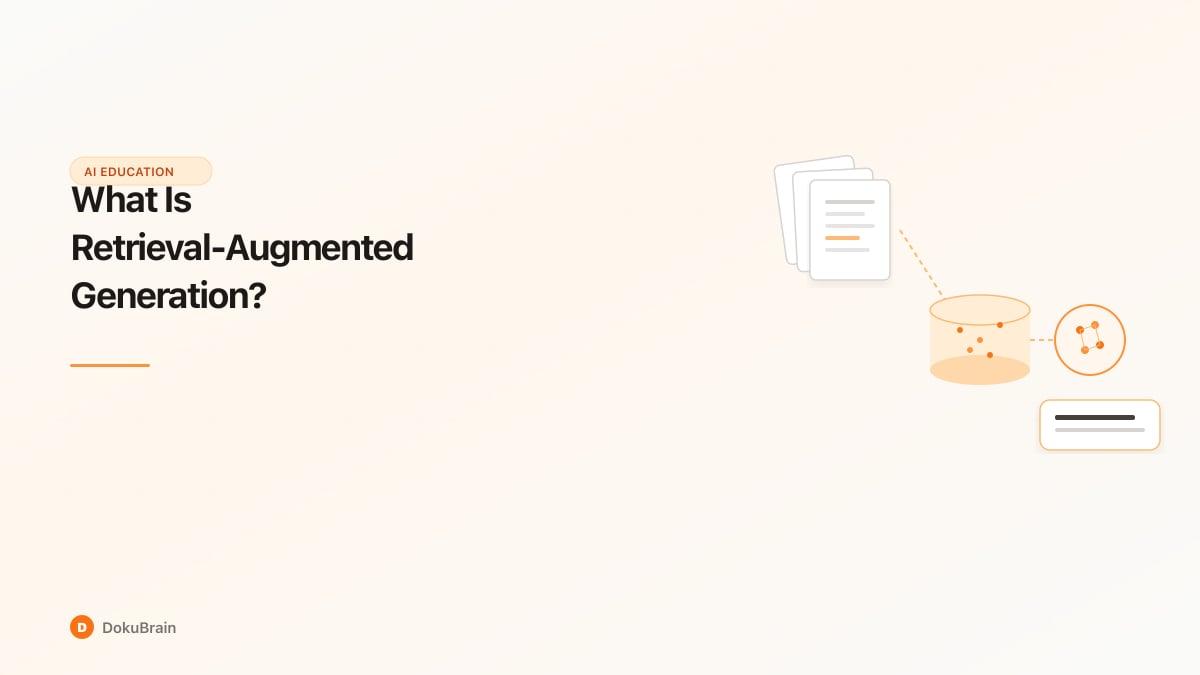
RAG in One Sentence (Then the Full Explanation)
RAG is a technique that lets AI answer questions by first finding relevant information in your documents, then using that information to generate the answer. In one sentence: RAG augments AI generation with retrieval from your own data.
The full explanation: Large language models are trained on massive amounts of public data. They can write, summarize, and reason — but their knowledge has cut-off dates, they cannot access your private documents, and they sometimes hallucinate facts. RAG solves this by adding a retrieval step. When you ask a question, the system searches your document library for relevant passages, passes those passages to the model as context, and the model generates an answer grounded in that context. The result is an AI that knows your business without you retraining it.
How RAG Works: Step by Step
Step 1: Indexing. Your documents are split into chunks (typically a few hundred words each). Each chunk is converted into an embedding — a vector of numbers that represents its meaning. Embeddings are stored in a vector database.
Step 2: Query. The user asks a question. That question is also converted into an embedding.
Step 3: Retrieval. The system finds chunks whose embeddings are most similar to the question embedding. This is semantic search: it matches meaning, not just keywords. The top 3-10 chunks (configurable) are selected.
Step 4: Augmentation. The retrieved chunks are inserted into a prompt alongside the user's question. The prompt tells the model: "Answer using only this context."
Step 5: Generation. The model produces an answer based on the provided context. The answer includes or can be linked to source citations. Because the model is constrained to the context, hallucinations drop significantly.
Why RAG Matters: The Problem It Solves
The problem RAG solves is the knowledge gap. LLMs know a lot, but they do not know your internal policies, your contracts, your financial reports, or your product documentation. Giving an LLM access to the entire internet is impractical and risky. Fine-tuning a model on your documents is expensive, slow, and requires expertise. RAG offers a middle path: your documents become the model's context at query time.
RAG also addresses hallucination. When an LLM answers without grounded context, it can confidently state false information. Studies show that RAG reduces hallucination rates by 50-70% compared to context-free generation. For enterprise use — compliance, legal, finance — accuracy is non-negotiable. RAG provides the guardrails.
Finally, RAG is updatable. When you add or change documents, you re-index. The next query uses the latest content. No retraining. No waiting for a new model release. This makes RAG ideal for organizations whose knowledge base evolves constantly.
RAG vs Fine-Tuning: What Is the Difference?
RAG and fine-tuning both customize AI for your data, but they work differently. Fine-tuning modifies the model's weights by training on your examples. The model "learns" your data. RAG keeps the model unchanged and retrieves your data at query time. The model "reads" your data when answering.
Fine-tuning is better when you need the model to adopt a specific style, format, or narrow task (e.g., always output JSON in a particular schema). It requires significant training data and compute. Updates mean retraining. RAG is better when you have a large, changing corpus and diverse question types. Updates mean re-indexing. RAG is typically faster and cheaper to deploy.
Many organizations use both: fine-tune for consistency and style, then augment with RAG for domain-specific knowledge. For document Q&A, RAG alone is usually sufficient and easier to operationalize.
RAG vs Traditional Chatbots: Why RAG Answers Are Better
Traditional chatbots rely on predefined scripts or search over FAQs. They match keywords and return canned responses. RAG chatbots retrieve real content from your documents and generate natural answers. A scripted bot might say "I do not have that information." A RAG bot finds the relevant policy section and explains it in context.
RAG answers are better because they are grounded. Every claim can be traced to a source. In regulated industries, this traceability is essential. RAG answers are also more comprehensive — they can synthesize information across multiple documents and summarize complex topics. A user asking "What are our remote work policies?" gets a coherent answer drawn from handbook, HR memos, and IT policies, not a list of links.
RAG chatbots also stay current. Update the handbook, re-index, and the next user gets the new policy. Scripted bots require manual updates to every affected response.
Common RAG Terms Explained (Embeddings, Vector Search, Chunks, Grounding)
Embeddings: Numerical representations of text that capture semantic meaning. Similar meanings produce similar vectors. Embeddings enable "meaning search" instead of keyword matching.
Vector search: Finding the nearest embeddings to a query embedding. Implemented in vector databases (e.g., Qdrant, Pinecone) using approximate nearest-neighbor algorithms. Returns the most semantically similar chunks.
Chunks: Segments of documents used for retrieval. Documents are split into chunks (e.g., 256-512 tokens) so retrieval can target specific passages. Chunk size trades off context completeness vs. precision.
Grounding: The extent to which a generated answer is supported by retrieved context. High grounding means the answer draws from the sources. Low grounding suggests hallucination. RAG systems often compute grounding scores to flag unreliable answers.
Lexical search: Keyword-based search (e.g., BM25). Hybrid search combines lexical and vector search for better recall — semantic for meaning, lexical for exact terms like IDs or names.
Frequently Asked Questions
What does RAG stand for?
RAG stands for Retrieval-Augmented Generation. It is a technique that augments AI text generation with a retrieval step that fetches relevant information from your documents before the model generates an answer.
How does RAG reduce AI hallucinations?
RAG constrains the model to answer using only retrieved context. By providing grounded source material, RAG reduces the model's tendency to invent facts. Studies show 50-70% reduction in hallucination compared to context-free generation.
What is an embedding in RAG?
An embedding is a numerical vector that represents the semantic meaning of text. Similar text produces similar vectors. RAG uses embeddings to find document chunks that are semantically similar to a user's question.
What is vector search?
Vector search finds the most similar embeddings to a query embedding. It enables semantic search — matching by meaning rather than exact keywords. Vector databases store embeddings and perform fast similarity search.
What is grounding in RAG?
Grounding measures how much of a generated answer is supported by retrieved context. High grounding indicates the answer is well-sourced. Low grounding suggests possible hallucination. Many RAG systems report grounding scores.
Do I need to fine-tune a model to use RAG?
No. RAG works with pre-trained models. You index your documents and pass retrieved chunks as context at query time. Fine-tuning is optional and used for different purposes, such as style or format control.
Ready to try it yourself?
Start processing documents with AI in seconds. Free plan available — no credit card required.
Get Started Free